


What Is the Cambridge Curriculum? A Complete Guide for Indian Parents (2027)
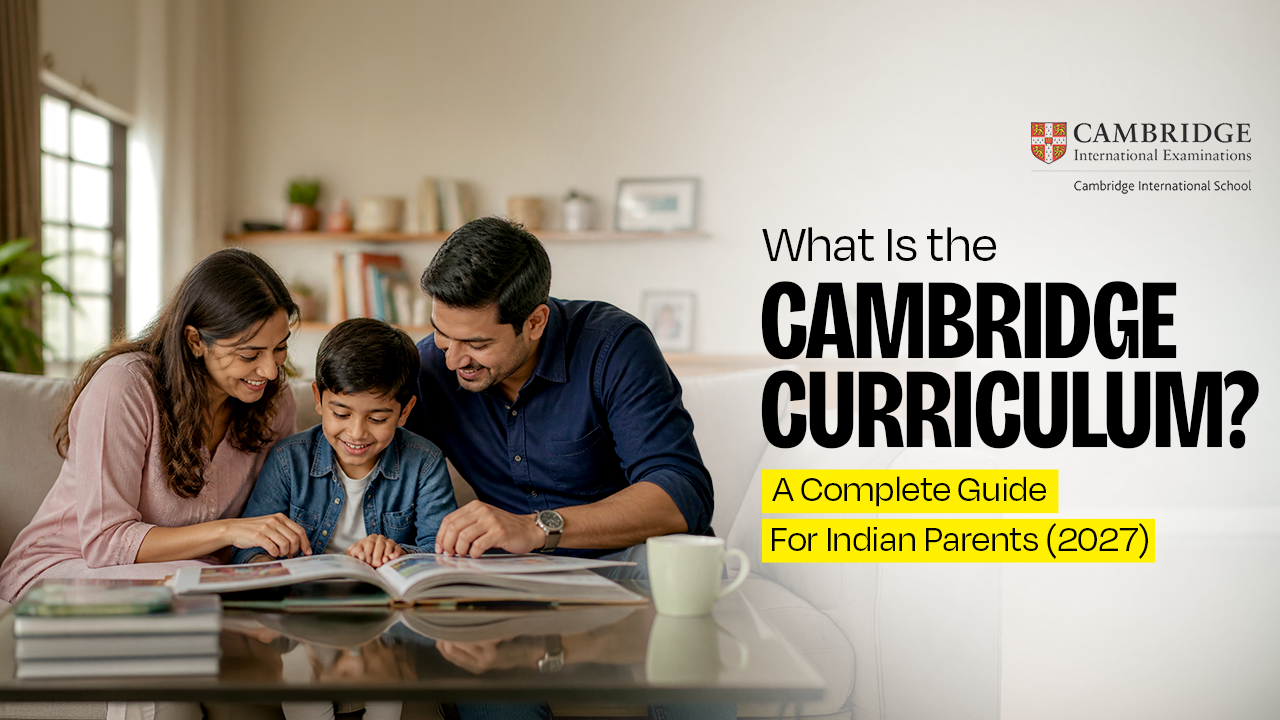
For Indian parents exploring alternatives to traditional school boards, the Cambridge curriculum can raise several questions: Is it the same as IGCSE? What happens after Class 10? Is it recognised by Indian universities? And how is it different from a conventional school curriculum?
The Cambridge Pathway is an international education framework for learners aged 3 to 19, covering five stages from early years to pre-university education. Rather than being a single examination programme, it offers different stages that progress from early years to pre-university education.
For parents, understanding this structure is more useful than simply thinking of Cambridge as an “international board.”
In This Article
What Is the Cambridge Curriculum?
The Cambridge curriculum is developed by Cambridge International Education, part of Cambridge University Press & Assessment. Its approach combines subject knowledge with skills such as independent thinking, applying knowledge, evaluating information, and communicating ideas clearly.
The Cambridge Pathway has five stages:
- Cambridge Early Years – age 3+
- Cambridge Primary – age 5+
- Cambridge Lower Secondary – age 11+
- Cambridge Upper Secondary – age 14+
- Cambridge Advanced – age 16+
A school does not necessarily have to offer every stage. Schools can choose which stages and subjects they provide.
To understand how the Cambridge Pathway progresses through secondary and senior secondary education, it is useful to distinguish between Cambridge IGCSE and Cambridge International AS & A Levels.
What Are Cambridge IGCSE and AS & A Levels?
Two qualifications are particularly important for secondary and senior secondary students.
Cambridge IGCSE
Cambridge IGCSE is generally taken by students aged 14–16 and forms part of the Cambridge Upper Secondary stage. With over 70 subjects available, schools can offer different combinations according to their curriculum.
Assessment can include written examinations as well as oral, coursework, and practical components, depending on the subject. This means assessment is not necessarily based on one identical format across all IGCSE subjects.
Cambridge International AS & A Levels
At the Cambridge Advanced stage, students typically study Cambridge International AS & A Level qualifications from age 16 onwards.
The programme places greater emphasis on in-depth subject knowledge, independent thinking, evaluating information, logical reasoning, and applying knowledge to new situations. Cambridge offers 50+ subjects at this level, giving schools flexibility in the combinations they provide.
For students planning university education, this stage is particularly important because subject selection can be connected to future degree requirements.
Is Cambridge the Same as IGCSE?
| Cambridge Pathway | Cambridge IGCSE |
| The Cambridge Pathway is the broader five-stage framework covering education from Early Years to Advanced. | Cambridge IGCSE is a specific qualification within the Cambridge Upper Secondary stage, generally taken by students aged 14–16. |
| It includes different stages and qualifications, including Cambridge IGCSE and Cambridge International AS & A Levels. | It is one qualification students can take as part of their secondary education. |
| Schools can choose which stages and subjects they offer. | IGCSE offers a broad choice of subjects, allowing schools to create different subject combinations. |
In simple terms: Cambridge is the broader educational pathway, while IGCSE is one qualification within that pathway.
What Makes the Cambridge Curriculum Different from Other Boards?
The Cambridge approach places emphasis on understanding, applying knowledge, and developing independent thinking. Students may be expected to:
- Apply concepts to different situations
- Analyse and evaluate information
- Construct reasoned arguments
- Communicate ideas clearly
- Develop deeper understanding within individual subjects
However, the exact classroom experience depends on the school and the subjects selected. Cambridge sets the syllabus, while how it is taught depends on the school. Assessment methods can also vary by subject and may include coursework, practical exercises, oral or listening tests, projects, and written examinations.
This is why parents should evaluate the school delivering the Cambridge curriculum, rather than assuming that every Cambridge school will offer an identical experience.
Is the Cambridge Curriculum Recognised in India?
Yes. Cambridge qualifications have a formal recognition and equivalence framework in India. Cambridge states that five Cambridge IGCSE or Cambridge O Level subjects, including English Language, are equated to Grade 10, while Cambridge International A Levels in three subjects are equated to Grade 12 in the Indian schooling system.
However, equivalence does not automatically guarantee admission to every Indian university or course. Institutions may have their own academic, subject, and entrance requirements. Students should therefore check the requirements of the specific course and university they plan to apply to.
How to Choose a Cambridge School in India
The Cambridge curriculum can offer flexibility, but the right school matters just as much as the curriculum itself. Before admission, parents should check:
- Which Cambridge Pathway stages the school offers
- Which IGCSE and AS & A Level subjects are available
- How subjects are combined and assessed
- What academic support the school provides
- Whether the school is officially registered with Cambridge
- Whether its subject choices align with the student’s likely higher-education plans
Parents can verify a school’s registration through Cambridge’s official Find a School directory rather than relying solely on a school’s marketing claims. Cambridge states that schools offering its qualifications must be registered with Cambridge.
Is the Cambridge Curriculum Right for Your Child?
The Cambridge curriculum can be a strong fit for students who value subject choice, depth of study, and opportunities to apply what they learn. For families considering a Cambridge school in India, the key question is not whether Cambridge is simply “better” than another board, but whether its learning approach suits the student.
With pathways such as Cambridge IGCSE and AS & A Levels, students can build a subject combination that supports their academic interests and future plans. Ultimately, the right international curriculum in India is one that matches a student’s learning needs, strengths, and long-term goals.
Frequently Asked Questions
After Cambridge IGCSE, students can progress to Cambridge International AS & A Levels or another suitable senior-secondary pathway, depending on the school and their future academic plans.
Yes. Cambridge qualifications are recognised in India, subject to individual university and course requirements.
No. Cambridge qualifications can also support progression to universities in India.
No. Schools can choose which stages and subjects they offer.
Yes. Students can transfer between Cambridge schools, including when moving to another country. The transfer is handled by the schools, and the receiving school decides whether it can accept the student.