

CBSE vs Cambridge Curriculum: Which Is Right for Your Child in Jaipur?
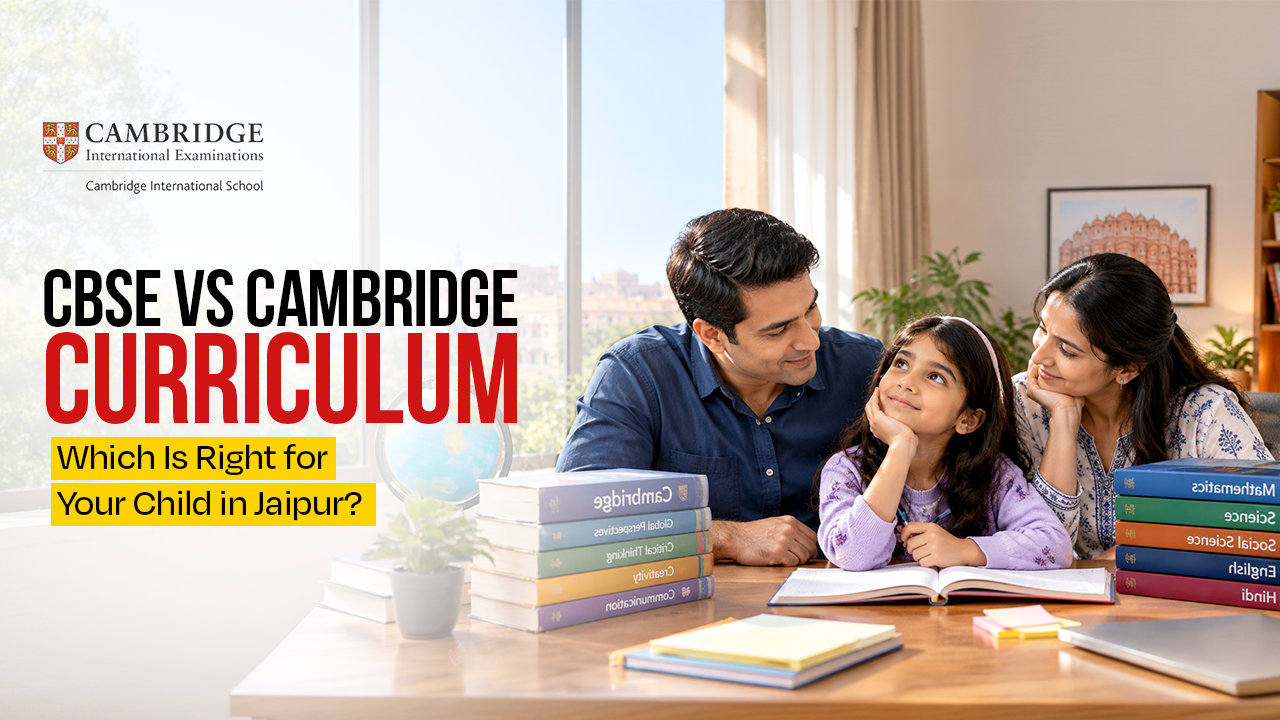
Choosing a school in Jaipur often means looking beyond the board name. Parents comparing the CBSE vs. Cambridge curriculum are also considering how each pathway approaches subjects, assessment, and students’ wider learning experience.
CBSE follows an Indian school education framework, while Cambridge International offers a multi-stage pathway with qualifications including Cambridge IGCSE and Cambridge International AS & A Level. Their subject structures and assessment approaches therefore differ, particularly as students move into secondary and senior-secondary education.
The right comparison is ultimately about fit rather than a universal winner. Parents should consider their child’s learning preferences, subject interests, future education plans, and the way each individual school implements its curriculum.
In This Article
CBSE and Cambridge: What Is the Basic Difference?
CBSE is an Indian school education board with a structured curriculum and assessment framework. Cambridge International, by contrast, offers a five-stage Cambridge Pathway covering Early Years, Primary, Lower Secondary, Upper Secondary, and Advanced education.
For a secondary-school comparison, Cambridge IGCSE is the relevant qualification within the Cambridge Upper Secondary stage, generally intended for students aged 14–16. At the next stage, Cambridge International offers AS & A Level qualifications through its Cambridge Advanced pathway.
This distinction matters because “Cambridge” does not refer to one single curriculum or qualification. The subjects, assessment methods, and learning expectations depend on the specific Cambridge stage and qualification a student is taking.
| Aspect | CBSE | Cambridge International |
| Education system | An Indian school education board with a structured curriculum and assessment framework. | An international education pathway covering multiple stages of schooling. |
| School stages | Secondary and senior-secondary stages covered in this comparison include Classes IX–XII. | Cambridge Pathway covers Early Years, Primary, Lower Secondary, Upper Secondary, and Advanced stages. |
| Secondary framework | CBSE prescribes curriculum and assessment frameworks for the relevant classes and subjects. | Cambridge IGCSE is part of the Cambridge Upper Secondary stage and is generally taken by students aged 14–16. |
| Subject structure | Offers prescribed subjects and a range of academic, skill, and elective subjects, depending on the class and school’s offerings. | Cambridge IGCSE offers 70+ subjects internationally, but individual schools decide which subjects they provide. |
| Assessment | Assessment requirements vary by class and subject and can include examinations and school-based assessment. | Assessment varies by IGCSE subject and may include written examinations, oral assessments, practical assessments, or coursework. |
| What parents should compare | The school’s subject combinations, assessment approach, teaching practices, and support systems. | The Cambridge stage offered subjects actually available, assessment methods, and how the programme fits the child’s educational plans. |
For parents in Jaipur, this means that comparing a CBSE school in Jaipur with a school offering Cambridge programmes is more useful when the comparison is made at the same educational stage. A parent considering Classes IX–X should look specifically at the secondary curriculum and subject options, while a parent considering a Cambridge school should check whether the school offers Lower Secondary, IGCSE, or a later Cambridge qualification.
Learning Approaches in CBSE and Cambridge
CBSE’s current curriculum highlights competency-based education, experiential learning, flexibility, and holistic development. Cambridge IGCSE, meanwhile, describes its curriculum as flexible and focused on developing knowledge, understanding, creative thinking, enquiry, and problem-solving.
A curriculum framework does not fully describe a child’s school experience. Two schools following the same curriculum can differ in teaching methods, classroom interaction, subject availability, assessment practices, academic support, and co-curricular opportunities. Parents should therefore compare the actual school alongside the curriculum.
This is particularly relevant in Jaipur, where parents may find schools offering different curricula, stages, subject combinations, and approaches to classroom learning.
Assessment Approaches in CBSE and Cambridge
Assessment is another important factor when comparing CBSE and Cambridge.
CBSE schools follow the assessment and examination framework prescribed for the relevant class and subject. The current CBSE curriculum places emphasis on competency-based education and assessment, with attention to students’ application of knowledge and skills.
The Cambridge IGCSE assessment varies by subject. Depending on the syllabus, it can include written examinations, oral assessments, practical assessments, and coursework. The specific assessment method and weighting depend on the individual subject syllabus.
For parents, the important point is to look beyond the board name and check how the subjects your child is likely to study are actually assessed.
Subject Choices in CBSE and Cambridge
Subject choice becomes increasingly important as students move towards secondary and senior-secondary education.
CBSE provides a range of academic, elective, and skill subjects, with the actual combination depending on the class and the school’s offerings. Cambridge’s international subject catalogue is much broader than what any individual school necessarily offers.
Parents should therefore compare the school’s actual subject list, not the full Cambridge catalogue.
A Simple Framework for Choosing Between CBSE and Cambridge
Rather than deciding based only on the curriculum name, parents can compare the two pathways against their child’s circumstances.
| Consideration | What Parents Should Consider |
| Learning preferences | Does the child respond well to enquiry, application, discussion, and different types of learning activities? |
| Assessment | Which assessment formats are relevant to the subjects the child is likely to study? |
| Subject interests | Are the child’s preferred subjects available at the school and at the relevant stage? |
| Future education | Does the family expect the child to pursue higher education in India, overseas, or either? |
| Board transition | If a change of curriculum may happen later, what subjects, grade requirements, and admission conditions will apply? |
| School environment | How does the individual school implement its curriculum in classrooms? |
| Academic support | What support is available if the child needs additional help or greater academic challenge |
Board changes can also affect continuity. If a child moves from one curriculum to another, parents should check the subjects already studied, the grade being entered, admission requirements, and whether the new school considers the previous academic record sufficient for placement. The practical transition depends on the schools and stages involved.
What Parents Can Check During a School Visit
A school visit can provide information that a curriculum comparison alone cannot. Instead of asking only which board the school follows, parents can ask specific questions about how the programme operates.
- Ask for the actual subject list for the grade your child will enter, rather than relying on the full CBSE or Cambridge subject catalogue.
- Ask how assessment works in the subjects your child is considering, including examinations, practical work, coursework, or other assessment components where applicable.
- Ask about academic support, including how the school supports students who need additional help and those who are ready for greater depth.
- Ask about progression and continuity if your child may change curriculum or move between stages later.
- Observe the classrooms and teaching environment where possible. The way a school implements its curriculum can differ even when two schools follow the same broad pathway.
The goal is not simply to identify a board. It is to understand what your child will actually study, how they will be assessed, and what support and progression the school provides
Exploring Cambridge Schools in Jaipur
Once parents understand the difference between CBSE and Cambridge, the next step is to compare the schools offering these programmes in Jaipur. The school-level details matter because not every Cambridge school offers the same stages or subjects.
The Seedling Cambridge schools in Jaipur offer Cambridge programmes spanning Primary, Lower Secondary, IGCSE, and A Level. The schools operate campuses in Jawahar Nagar and Durgapura, Jaipur.
Parents considering the Cambridge route should check the specific stage available for their child’s entry grade, the subjects offered, assessment methods, academic support, and arrangements for progression to the next Cambridge stage. These details can be more relevant to the child’s day-to-day experience than the curriculum name alone.
Official Sources
- CBSE Curriculum 2026–27: CBSE Academic Curriculum 2026–27
- Cambridge IGCSE Curriculum: Cambridge International IGCSE Curriculum
- Cambridge Pathway: Cambridge International Pathway
Frequently Asked Questions
It can be possible, but the practical requirements depend on the child’s grade, the school’s admission policy, and the Cambridge stage being entered.
No. Cambridge qualifications are internationally used and recognised, and students can use them when applying for higher education in India or other countries, subject to the requirements of the institution and programme.
Some Cambridge IGCSE subjects include practical, oral, or coursework components, while assessment varies by subject.
Yes. Parents should check the child’s current grade, subjects studied, admission requirements, and the Cambridge stage they would enter before changing curricula.
No. Cambridge provides a broad international subject range, but individual schools decide which subjects they offer. Parents should check the actual subject list for the school and grade they are considering.